 We finished dinner. I pressed my neatly folded napkin to my lips. As we waited for coffee, silence hung heavy in the air. My client writhed in her seat and hung her head as she asked, “I read your article on control towers, but I am confused. What is an easy definition? I am embarrassed to ask, but we discussed the topic at our board meeting yesterday, and I must admit that we have more confusion than clarity.”
I smiled. For me, this type of discussion is the norm. This week, in advisory calls, I answered five questions on control towers. Call volume is brisk. However, when it comes to the interaction, I find that everyone wants one, but no one knows what they are asking for. The industry is moving down a path of “groupthink.”
What Is Groupthink?
Groupthink happens when teams think that they have a consensus but follow a herd mentality using irrational decision-making processes. In my interactions with supply chain teams, I find that this type of decision process happens frequently. It looks like this. Groups throw out concepts. They sound good. Folks shake their heads in agreement, but no one defines terms, and the goal is unclear. As a result, people have a false sense of agreement.
Business Use Cases
There is no class of technologies, or common definition, for “supply chain control towers.” Instead, a project needs to be based on user-defined set of capabilities. In this blog post, I give a framework to drive discussions.
Visibility. The most common use case for control towers is visibility. While there are many types of visibility (see Figure 1), the most frequent use case is either sourcing or transportation visibility. It is an ideal use case for prescriptive or cognitive analytics to sense, learn and act.
Figure 1. Gaps in Enterprise Visibility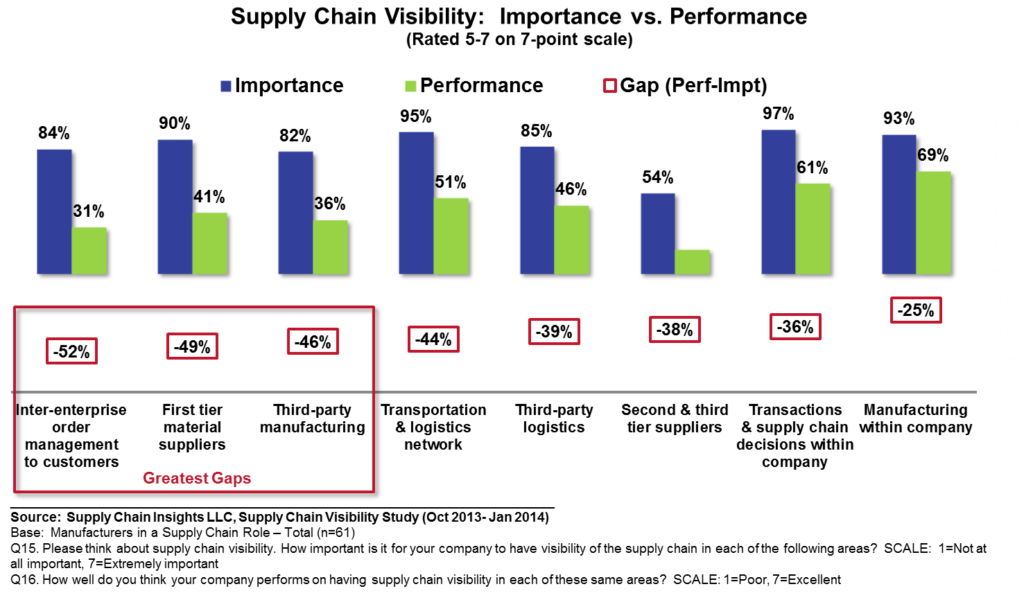 In the visibility use case avoid three watch-outs:
1) Make Sure That The Data Is Actionable. Let’s take telematics. In many deployments of telematics, companies get visibility on truck status, but the data is overkill. What is received and what is needed are different. The telematics providers transmit frequent signals on status, but the data lacks performance context. For example, the goal is not to track truck location but to provide insights on location in context with a delivery appointment. For example, “Will the truck be late to arrive against a pre-established appointment?” Most companies want a system with prescriptive analytics to tell them when a shipment is expected to be late and what action to take. This capability is beyond what is possible for most telematics providers.
2) Latency. Contract manufacturing or 3PL data often will have a 24-hour latency due to batch integration. In deployment, take time to understand data latency. Make sure that the data is harmonized to ensure all data has the same time reference. One client I visited built a great room to monitor yesterday’s data. When they built the project, they did not realize that they did not have access to daily data daily for their third-party warehouses and contract manufacturing locations.
3) Granularity. Mapping. Master data. The devil is in the details. My advice? Dance with the devil. Understand the details. Focus on data portability using ISO-8000 standards and authoritative identifiers.
Last week, I was at a customer who shipped to distributors and did not know the site of customer facilities. As shown in Figure 2, many companies do not know the location of second and third tier suppliers. Their data maps are complex, but enterprise centric.
Figure 2. Gaps in Supplier Visibility
Measurement. Companies are drowning in data, but struggle to get insights. As shown in Figure 3, companies struggle to get data to make decisions. The focus is on functional metrics, but most cannot get to overall supply chain metrics. For example, only 29% of manufacturing companies can access total cost data, and 31% struggle to see the impact of business decisions on inventory. So, one business use case for control towers is accessing supply chain key performance indicators. The average company has five-to-seven Advanced Planning Systems (APS) and twelve Enterprise Resource Planning (ERP) Solutions. While performance monitoring is not the most common use case for a control tower project, the gap exists.
Figure 3. Company Effectiveness Using Data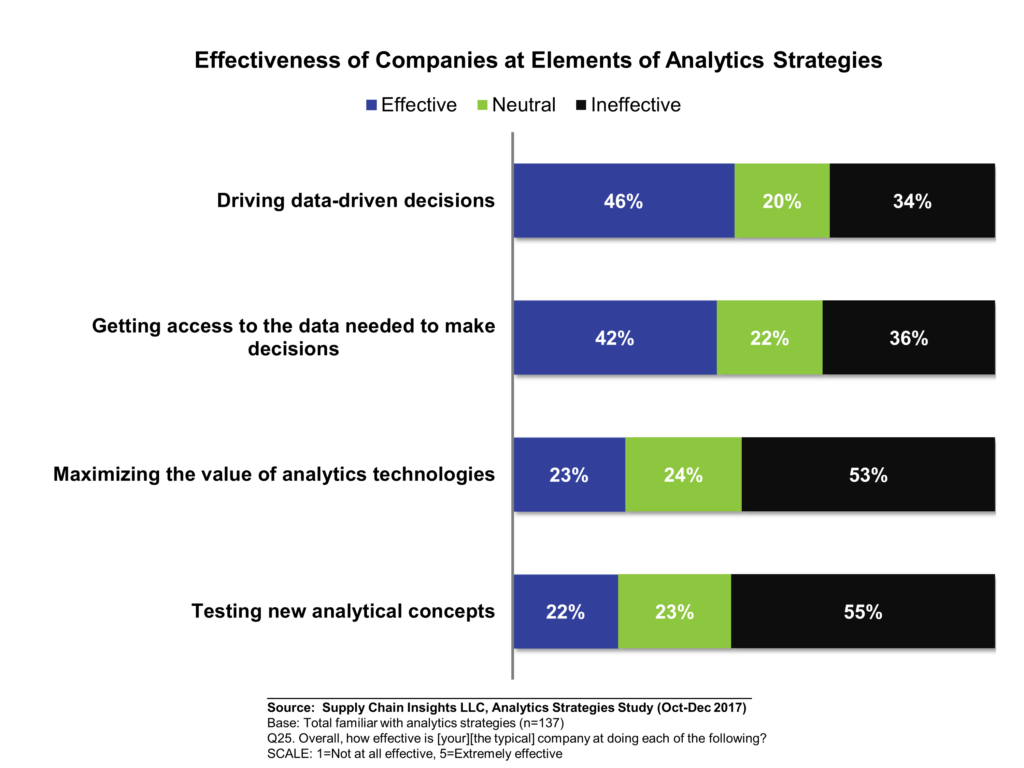
The use of digital twin technologies enables discrete event simulation to understand the trade-offs of scenarios on outcomes.
Control. Focus On Outcomes. The reference for supply chain leaders is an airport control tower. In their mind, they visualize the status of planes landing. As they speak, they confuse the concepts of visibility and control. How so? The goal of an airport control tower is to land planes safely. The moment of truth for the control tower is when the wheels touch the tarmac and the plane safely lands. The visibility of the planes on the screen is a means to an end. If the project focuses on control, be clear on what you are trying to control and measure the outcome using control charts. Remember the principles of control theory. (I was lucky enough to get to take this class twice. (smile) It was one of the most profound courses I took in chemical engineering school. Supply chains are complex, non-linear systems. Carefully design control systems to compare reference data to desired outcomes using control theory. Most initiatives lack this level of discipline. Why? There is no reference data or well-defined control limits.)
Let’s take an example: order fill rate. This is a goal for many companies, but few understand the root issues driving order shortages. If we apply control theory to order fill rate, the first goal is establishing the right reference data. This will raise many questions. Should it be the original order? How to manage backorders? The discussion on defining the right reference data must precede the implementation.
In Table 1, I share examples.
Table 1. Sample Objectives for Control Towers
Listening. Call center data. Warranty data. Quality data. These are all great candidates for listening. Listening posts use sentiment analysis based on unstructured text mining. Organizations are poor at listening and the use of unstructured data. Figure 4 is a case study from Lenovo. This is a control center to mine consumer review data to control supplier part quality. This team meets weekly to review customer review data and connect the comments to supplier quality.
Figure 4. Example of Social Sentiment Analysis
Considerations:
When you hear the term control tower, raise you hand and ask for clarity. Get clear on terms, inputs, and outputs. Build with the goal in mind. Each of the four examples in this post are valid use cases, but require different architectures. While they may seem similar to a business leader, they are very different projects for the Information Technology (IT) team.
As you move on the journey side-step these pitfalls:
- Real-time? Really? Groups rally around the concept of real-time. When an individual in a strategy session says real-time data, everyone shakes their heads yes. My caution? Not all data needs to fly first class. Instead, focus on processing data at the speed of business.
- Focus on Flows. The gap is usually that the information flows are one-way not bidirectional. Most teams focus on integration versus portability. This is a paradigm shift.
- Make Data Usable. Too much data, that is not digestible, can kill a great initiative. Let’s take telematics data. I had dinner this week with a business leader. We were discussing the Company’s implementation of Four Kites. Data was only available from 50% of their carrier base. They were getting a lot of data, but not all were usable. The frequency of data created noise in the system, causing nervousness. As a result, there was a lot of data, but it did not drive value.
- Think Beyond Rows and Columns. Most supply chain teams are hard-wired to think in rows and columns using structured data. We are drowning in data and thin on insights. Pictures, images, text, email, sentiment, contracts, and documents are all areas of opportunity. However, to use these data sources, we must break paradigms and focus on using non-relational techniques.
- Design Thinking. How Will the Data Be Used? Design with the goal in mind. Focus on business use cases.
So What? What Now?
The next time that someone in a meeting mentions the term control tower ask for a definition. Get clear on what you are trying to control. Summon the courage to get asked tough questions. If it is a visibility project instead of a control tower, get clarity on the visibility objective. I find that most companies confuse the term visibility with control. Without clear definitions of projects expect failure.
My Rant.
Control tower projects are a rabbit trail. What is a rabbit trail? The analogy is a meandering path that does not lead to business outcomes. (So you say, nothing like a rabbit trail driven by groupthink? Here I smile. I hope that groups take a pause.)
My take? The concept of control towers is over-hyped by technologists driving buzz. Buzz without clarity and specific use cases drives hype but not value. Can we step back and put some logical thinking into these discussions?
I look forward to hearing your thoughts.