
Rodanthe is one of my favorite beaches. During the summers, when I lived in Atlanta, I would pack my bikes on top of the car and head to this wonderful, and what was then a remote beach, on the Outer Banks of North Carolina. In the mornings, I would bike to a wonderful bakery, eat an Apple Ugly (an amazing pastry) and sit and drink coffee while staring at the ocean.
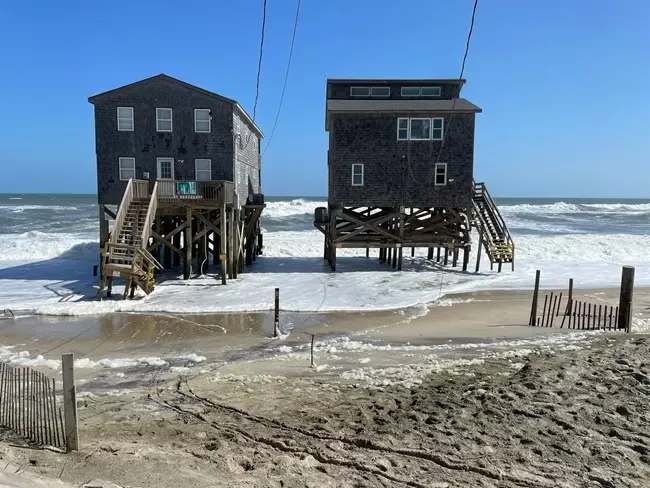
Today, beach erosion from fierce storms and rising tides, threaten many homes on this battered beach. This month, in an unprecedented move, the United States National Park Service bought two homes for $700,000 to tear down and return the area to a public beach.
Last night, I could not sleep. When I am restless, I read articles on my phone. This notice of the Rodanthe house purchase by the National Park Service was listed in my news feed above an article that Elliott Management Partners announced a confirmed 13.8% stake in E2open (ETWO) and was considering a takeover of E2open to return the company to private status.
Software Survival in Battered Seas?
Currently, E2open has a market cap of $823 million. The stock fell 60% year-to-date. The reason? Disappointing revenues. On August 31, 2023, E2open reported fiscal second-quarter reporting. While the company’s adjusted earnings of $0.04 per share were roughly in line with expectations, its quarterly revenue of $158.5 million missed estimates by around $1.5 million. The issue was the continual restatement of revenues. On the call, E2open reduced its full-year guidance, calling for revenue of $625 million down from restatements of $635 million (down from $655 million and $670 million previously).
Elliott Equity Partners believes E2open (ETWO) is undervalued and plans to engage with management and the company’s board on strategic opportunities. On October 10th, the company announced that Michael Farlekas, the Chief Executive Officer of E2open parent holdings, was stepping down. 2022 Mr. Farlekas received a total compensation of $7,587,409 after taking the company public on February 5th, 2021, through a SPAC.
This SPAC lined the management team’s pockets and gave E2open funds for a buying spree. E2open acquired ten companies, including BluJay Solutions, in the past five years for $1.7B. This buying spree followed a prior decade of seven software purchases. Over the period, the company systemically purchased companies for their recurring revenue stream but struggled with software and business integration. Due to this organizational dysfunction, employees took maturing stock options and resigned.
My last conversation with Michael Farlekas was tough. Michael called me when I wrote that the company had lost its way. He was angry. Michael was very proud that he returned the company to profitability, closing offices in the Bay Area and relocating to Austin, TX. My point to Michael was that a software company needs to be profitable, but it also needs to drive compelling value to its customers.
In the formative stage, E2open was a consortium to enable a B2b network for high-tech firms like Dell, IBM, Motorola, and Seagate. Under prior management, the company purchased some software planning assets, but under Michael’s leadership, the primary focus was on the automation of supply chain execution. The problem? The pieces did not fit together to build a coherent story. Under Michael’s leadership, I could not assemble the software flows to deliver a compelling business value. The piece parts were just that. They did not fit together well.
Summary
Let’s work on the analogy. While the National Park Service will purchase the houses in Rodanthe and return them to public lands, the land in Rodanthe still has value. Elliot may take E2open private to redefine the portfolio, but does E2open still have value in a rapidly changing market? I am not so sure. The problem with E2open is that the assets are old, and the company’s primary market–the logistics sector–is being battered like the homes on Rodanthe. I fear that E2open is doomed to fall into the sea of irrelevance. The sales force will struggle to answer the fundamental questions of “Why E2open? And “Why Now?” Current E2open customers need to assess the risk and evaluate alternatives.
History of Articles on E2open’s Slow Fall into the Irrelevant Sea:
The Saga of Supply Chain Innovation – Supply Chain Shaman
E2open Acquires Zyme: A Bridge Too Far? – Supply Chain Shaman
E2open Acquires Steelwedge. Impact on Market? – Supply Chain Shaman