Lora's Latest Post

S&OP Improves Alignment and Agility


Why am I focused on the supply chain? The answer is simple. It is a barometer of my business. All the problems show up first in the supply chain….”
— Dell Founder, Chairman and CEO, Michael Dell
I love this quote from Michael Dell. It came from an interview when I was writing the book, Bricks Matter.
Leaders are clear that good planning matters. The rest of the world continues to look for evidence. As a researcher, I am attempting to measure the impact.
Over the course of the last week, I have been writing about maturity in supply chain planning. This week, we will be sharing research from over 90 respondents on Sales and Operations Planning (S&OP). It is from a new quantitative survey. Check out our new report.
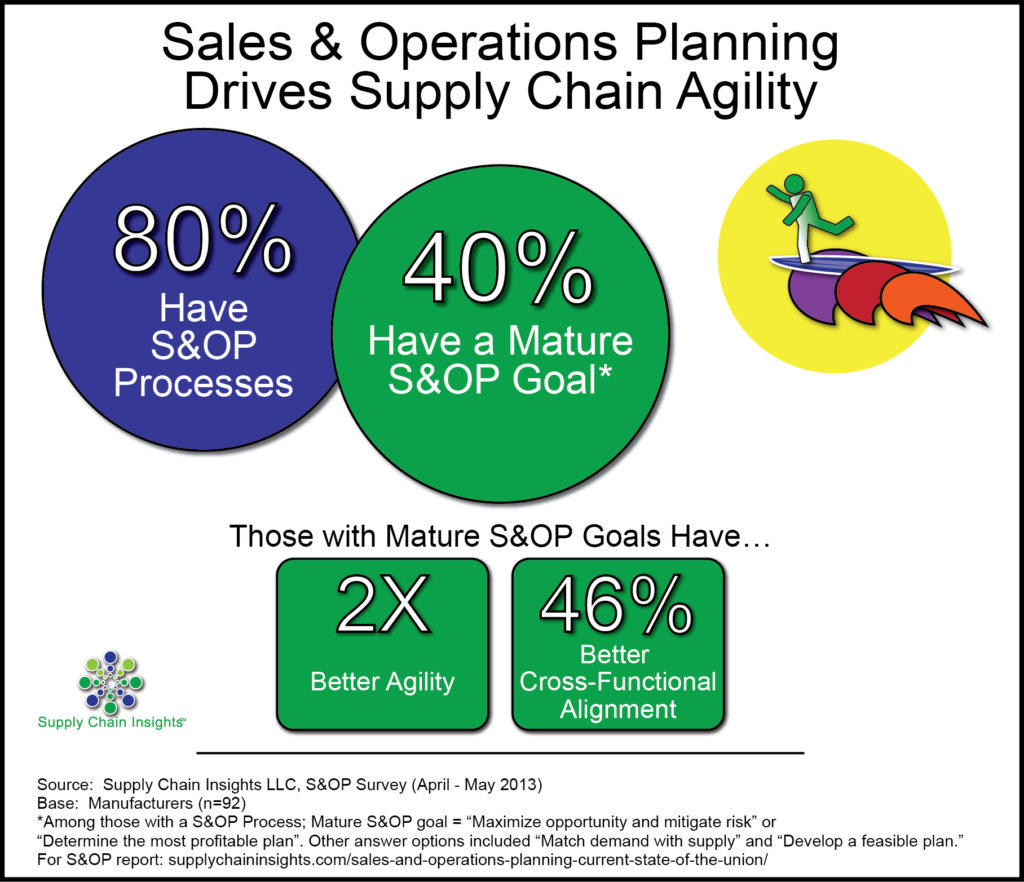
In this report, we find that S&OP processes have grown more complex in scope and governance over the last decade. The average company over 3B$ in annual revenue has four S&OP processes. We also find that S&OP maturity matters. As companies mature in S&OP that they rate themselves 2X more mature on ability and 46% better on cross-functional alignment.  To accomplish this, the goal of the S&OP process needs to move from a focus on volume to evaluate product mix/profitability. Companies the most mature in “what-if” analysis and the use of optimization tend to rate themselves higher in maturity.
Who doesn’t want a more agile and aligned organization?  Don’t miss this webinar on Thursday, June 13th at 1:00 PM.  We hope to have you join us!


Search the Archives
Search
Share this Post
Email
Twitter
LinkedIn
Facebook
Pinterest
WhatsApp
Featured Image
Recent Posts

Case Study: A Scrappy Demand Management Approach

This study of Franklin Sports shines a light on the work that needs to be done at the sales account level to challenge a retail forecast, and also highlights the importance of a new technique for a forecast engine — reinforcement learning.

Artificial intelligence comes in many forms — large language models, generative AI, machine learning, unstructured text mining, deep learning, neural networks, reinforcement learning, agents, and agentics. While the industry is wigging out about agentics, I think reinforcement learning is a great step forward in the journey of Artificial Intelligence.


Read More »

Can We Side-Step the AI Spin Cycle?

When it comes to combining tech, 1+1+1 should equal more than 1. The impact should be exponential. Unfortunately, today, the answer is 0.

What do I mean? Let me explain.

I find that the supply chain technology market moves slowly along traditional technology lines. Conferences are usually focused on the use of technology, not on redefining work. This bothers me. I want it to bother you as well.

Here I share some insights to drive change.

Read More »

Supply Chain Health Check: The Power of an Orbit Chart

An orbit chart is a powerful tool for understanding the “health” of a supply chain and its potential for improvement. The supply chain is a complex, non-linear system with limited trade-offs. The relationship between trade-offs varies by industry, region, and size. The orbit chart is a diagnostic we use in the Supply Chains to Admire work. Here I explain the use case.

Read More »

Are You Writing a Check You Cannot Cash?

Don’t let a well-intending, but ill-informed consultant or technologist set an expectation that you cannot meet. No when wins when there is a check written that cannot be cashed. In this case, the consultant will move to the next account leaving you holding the bag. Fight back with a data-driven argument. Help the organization think about inventory more holistically.

Read More »

The Sad Demise of the Food Industry

For the period of 2016-2025, the industry average was 11% operating margin and 7.82 inventory turns, with a 35% decline in industry inventory performance. Few companies were aware of or adapted to the shift in industry potential.
Today, the shifts are faster as consumers trade down to cheaper brands and retail private label gains market share. Major inflationary spikes in protein, especially beef and eggs, due to supply shortages and disease-related disruptions in 2025, continue the never-ending ride in commodity volatility. Yet, companies are insular to adapt their supply chain practices. Putting AI on top of traditional supply chain processes is a recipe for disaster.

Read More »