
If you ask companies if they would like better inventory and global supply chain visibility, you will get an overwhelming answer of, “Yes!” However, if you ask companies how they define and deliver global business visibility, you will get stares like, “Doesn’t everyone know what global visibility means?”
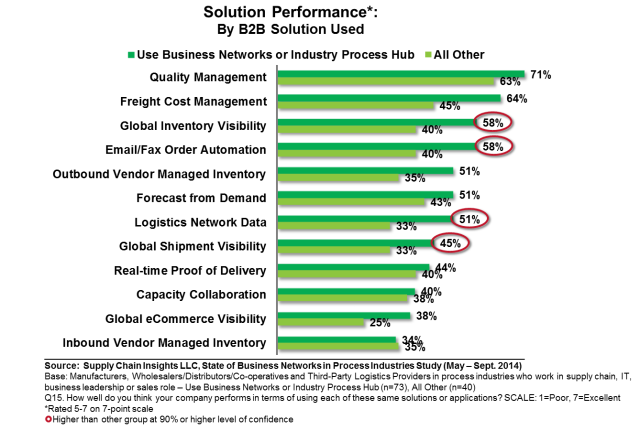
The answer is simple. They don’t. The term supply chain visibility varies by role. In our recent report on defining supply chain visibility in B2B networks, we provide a definition based on a research study of over 70 participants. In our recent work, we continue to try to understand the trends. In Figure 1, it is clear in process networks (the chemical, pharmaceutical, and food industries) that there is a significant difference in capabilities when companies use B2B Networks versus EDI, Fax, email, or spreadsheets.
Figure 1.
It is ironic. Today’s supply chain is more outsourced and subject to risk than ever before, and the technologies are more capable, but the average company runs the network on fax/emails and spreadsheets. Only 9% of flows in the value networks move through B2B networks, despite the compelling business value.
Today, I published a new report on building Digital Supply Chains. One of the first things I recommend that a supply chain leader tackles is B2B connectivity. The more research that I do, the more convinced I am that we have not powered our networks for success. EDI has too much latency, and spreadsheets and email are not equal to the challenge.
So as we enter 2015, I would encourage all supply chain leaders to get serious about building value networks. It is time to give it more than lip service. It matters. I can now prove that the difference in visibility is significant at a 90% confidence level. I hope this gives you confidence to get on with it and power B2B capabilities.
Enjoy the holidays. If you miss reading the Shaman in the next few weeks, and you want some new reading in the area of supply chain excellence, consider tucking my new book, Supply Chain Metrics That Matter, into your suitcase. Today, it is rolling off the presses, as I write, and it will ship from the Amazon warehouses on December 15th.

The book is full of research on building value networks; and as you read it, drop me a line. I welcome your feedback.
I look forward to cracking the first copy of the book and smelling the odor of ink. I may find it so intoxicating, that I will be compelled to write a sequel…. So, bring on the feedback. I am working on the plot… Let me know what you think happens to Joe (the character in Supply Chain Metrics That Matter that doesn’t want to be the ‘average’ Joe) in the next edition.


My Answer to Joe. The Future of APS
Traditional Advanced Planning Systems (APS) are unlikely to become true enterprise platforms because organizations remain functionally siloed, metrics are misaligned, and current APS architectures were designed for an environment that has fundamentally changed. Here I share how I think that APS systems can adapt to drive more value.