 This week, I spoke at the LLamasoft Summercon Conference. It was held at the University of Michigan in Ann Arbor. The conference was low-key. The University building was old, and well-worn. The doors hung precariously on their hinges, and the steps were uneven. The shelves needed a good dusting and the air was musty. It was far a cry from the neon and glitzy hotels of Las Vegas where I am often speaking.
On Wednesday, the theater at the Michigan League was bursting at the seams to hold over 500 attendees. The theater was packed. The attendees were sitting on the edge of their seats to hear about the next release of LLamasoft software. As I listened, I began to reflect.
Reflections
I remember the first time that I met the founders, Don and Toby. Don was quirky, and the company story was different. They came to Boston to tell us the story of LLamasoft. They also brought me and my colleagues at AMR Research stuffed Llamas. We laughed, and felt a bit silly, leaving the conference room holding our new furry tchotchkes. “What a crazy name! I wonder if they will make it?” we would exclaim. In a fit of giggles, we slapped each other on the shoulder in the coffee room and kibitzed, “Can you believe they brought US these crazy animals?” And from time to time, when we were behind deadline, and teasing each other about the looming weekly post, we would throw our llamas from cubicle to cubicle.
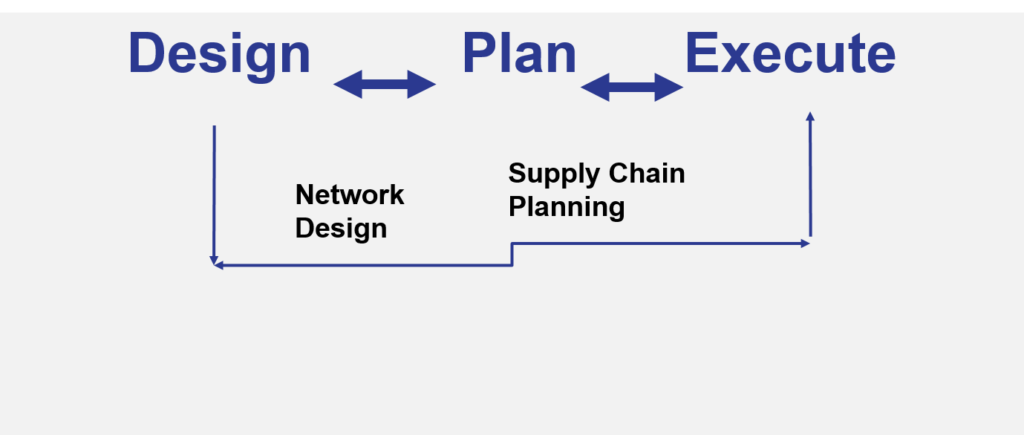
Figure 1.

Design as a Standalone Process
Today, LLamasoft, and the management of design processes, is no laughing matter. The company has skillfully navigated the market to survive and now thrive.
Ten years ago LLamasoft was an unlikely contender. The market for network design tools was growing at a moderate rate, and most of the market had invested in technologies from either i2 Technologies (then termed i2 Strategist) or Logictools. With the purchase of i2 by JDA, and Logictools by IBM, manufacturing companies serious about network design started looking for a company, with a well-established community, that was more serious about network design. The reason?
Today, supply chain design has become a process all to its own. In mature companies, it is no longer under the shadow of planning. As shown in the process flow, the design of the supply chain has become a closed loop process with planning and execution. Why? There are seven reasons:
- Customer Service. Demand and Supply Variability. With the rise in demand and supply visibility, it mattered more. It could no longer be just about inventory levels. Instead, the design needed to be more encompassing. To balance new requirements for customer service with a wider product platform, the focus needed to shift to be on the form (raw, semi-finished goods, and finished products) and function (design of cycle inventories, seasonal builds, safety stock and customized product strategies) of inventory. This analysis needed to be completed monthly and fed to newer forms of inventory optimization technologies.
- Mergers and Acquisitions and the Management of Global Operations. With mergers and acquisitions, and the management of global operations, it could no longer be an ad hoc process. Instead, it needed to be steps of continuous designs. As labor costs in China increased, the network needed to be more flexible. With the shifts in tax structures, the network design needed to morph. As a result, the financial and strategy teams became more interested.
- Ensuring Profitability. As Sales and Operations Planning became more important, supply chain design became more systemic. The goal was to translate volume and unit-based data into a profitability “what-if” analysis. The advanced LLamasoft user has a model on a computer tablet (Sherpa product) that enables the visualization of S&OP trade-offs within the S&OP meeting.
- Criticality of Corporate Social Responsibility. As corporate sustainability initiatives became more important, the design for carbon needed to be determined. As shown in figure 1, the gap in measurement and design for carbon is still a major opportunity.
- Resiliency. To build the right buffers in the supply chain, it was no longer just about designing physical flows and buildings; instead, the focus was shifting to designing process flows and decoupling points.
- Value-based Analysis. While discrete industries are good at the management of cycles, and process industries are good at the design of flows, as companies worked on Lean programs for value-stream analysis, they found that it was about the design of flows and cycles together. Network design tools were essential to manage the improvement of both together.
- Cost-to-Serve and Top-to-Top Meetings. The largest opportunities for companies lie in the gaps between the links of the supply chain. As companies attempted to implement new programs, downstream customers asked for suppliers to redesign for value.
It does not look the same at all companies; and no company is actively modeling against each of these goals. In fact, design as a standalone process is still evolving. In our research at Supply Chain Insights, we find that one in three companies greater than $1 billion in revenue has a supply chain center excellence; but only 50% are satisfied with their capabilities.
The gap is tough. Most companies are still struggling with “what good looks like” and “what defines supply chain excellence.” Most companies do not know how to manage this thing called supply chain, that is a complex system with increasing complexity. What they do know is that supply chain design helps.
Design Processes Grow Up
What is clear is that more and more companies are not willing to inherit their supply chains. They are on the journey of active design. The design of cycles and flows is becoming more important. It is serious business. So, as I cleared my throat to present at the Summercon conference, I looked into the eyes of over 500 supply chain professionals. It was the gaze of a serious crowd.
I smiled as I began to present the story of the “Metrics that Matter.” I was excited to share that companies that more actively design their supply chains outperform against their peer group on the Supply Chain Index. I encouraged them to be aggressive.
I look forward to writing their stories. I am convinced from three years of work on the Supply Chain Index that it matters.